
Types
Every value produced during a program analysis carries a type. In LiSA, the
type of a value determines which operations are applicable to it, how
assignments are checked, how type casts behave, and whether two values can be
mixed in, e.g., an arithmetic or logical expression. This page describes the type
hierarchy in LiSA: the core Type interface and its subtypes, the TypeSystem
that registers and reasons about types, and the concrete type families that
frontends use to model language-specific kinds of values.
All types in LiSA implement the Type interface, which acts as the single root
of the type hierarchy. Concrete type families extend it through a set of
sub-interfaces, each capturing a distinct kind of value: primitive scalars
(BooleanType, CharacterType, StringType, NumericType), in-memory
objects (InMemoryType, UnitType, ErrorType, ArrayType), pointer
references (PointerType, ReferenceType), and special sentinel types
(Untyped, VoidType, NullType). A separate TypeTokenType represents
type references appearing as first-class values in code.
This page contains class diagrams. Interfaces are represented with yellow rectangles, abstract classes with blue rectangles, and concrete classes with green rectangles. After type names, type parameters are reported, but their bounds are omitted for clarity. Only public members are listed in each type: the
+ symbol marks instance members, the * symbol marks
static members, and a ! in front of the name denotes a member with a default
implementation. Method-specific type parameters are written before the method
name, wrapped in <>. When a class or interface has already been introduced in
an earlier diagram, its inner members are omitted.
The Type Interface
The Type interface is the root contract that every type in LiSA must satisfy.
It provides a uniform API for type introspection, assignment compatibility, and
supertype resolution. For convenience, the following class diagram has a two column layout.
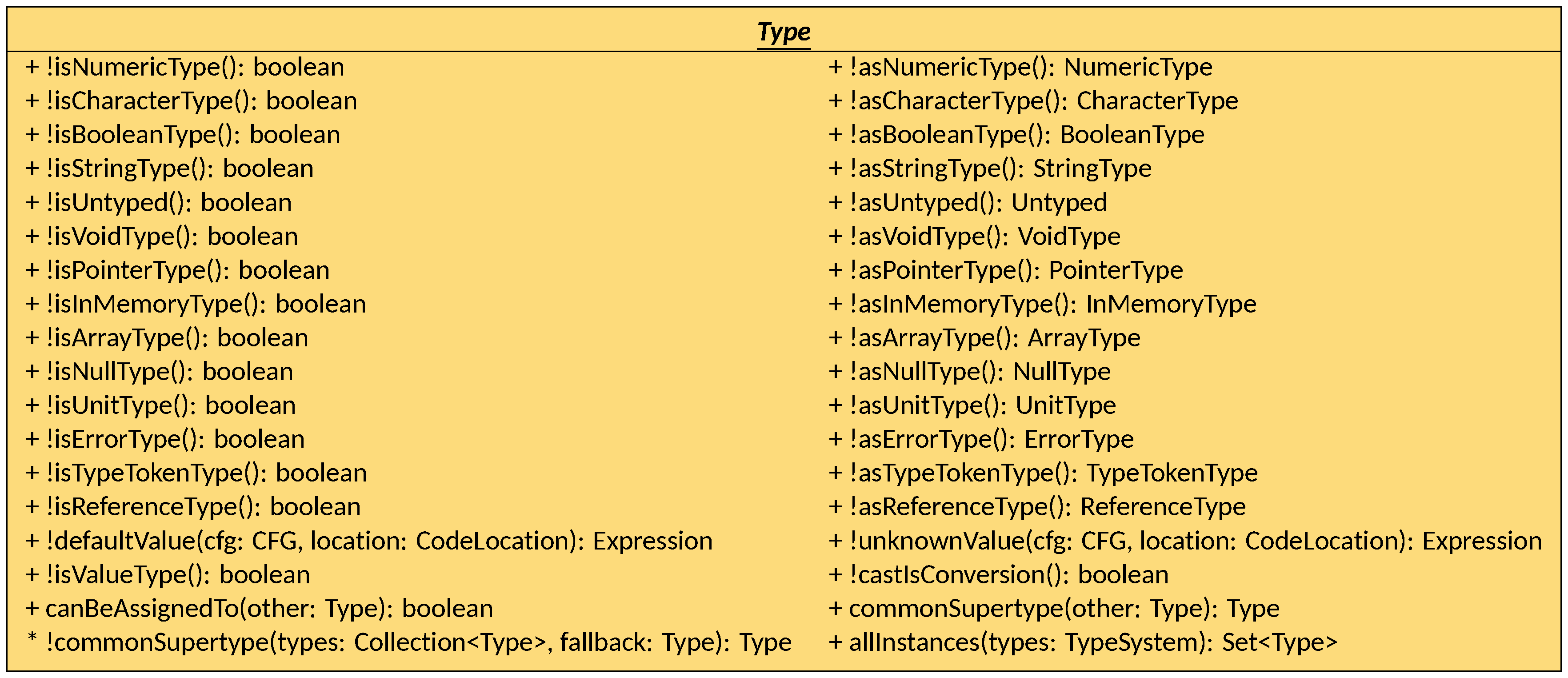
Three methods form the core abstract contract that every concrete type must implement:
canBeAssignedTo(other: Type)returnstrueif a value of this type can be used whereotheris expected (i.e., this type is a subtype ofother);commonSupertype(other: Type)returns the most specific type that is a supertype of both this type andother; when no meaningful supertype exists the method should returnUntyped.INSTANCE;allInstances(types: TypeSystem)returns all concrete instances of this type that are registered in the given type system; for singleton types this is a set containing only the singleton; for parametric types likeReferenceTypeit may expand to a family of instantiated types; for types that support inheritance this may include all subtypes as well.
The Type interface also provides default implementations of a large family of
type-test and type-cast helpers. For every sub-interface X in the
hierarchy, Type declares:
isXType()— returnstrueif this type is an instance ofXType;asXType()— casts this type toXTypeand returns it, ornullif the cast is not applicable.
Both methods have concrete default implementations, so sub-interfaces need not override them.
isValueType() is a convenience default that returns true when the type is
neither an InMemoryType nor a PointerType, identifying types that can be
used for local variables in most languages. Specifically, this method can be
used as a shortcut for ValueDomains to understand if they should track a
value or not. More information about ValueDomains can be found in the
Simple Abstract Domain page.
Two additional methods provide means to create values for a given type:
defaultValue(cfg, location)returns anExpressionrepresenting the default value of this type at the given program point (e.g.,0for an integer); the base implementation returnsnull, meaning no default exists;unknownValue(cfg, location)returns anExpressionrepresenting an unknown value of this type, implemented as aDefaultParamInitializationnode.
castIsConversion() returns true if a cast between types of this kind
actually converts the value (as opposed to merely reinterpreting the reference),
similarly to what happens in most languages when casting from a floating-point to an integer.
The base implementation returns false; BooleanType and NumericType
override it to return true.
The static helper commonSupertype(types, fallback) iterates over a collection
of types and computes their pairwise common supertype, returning fallback if
the collection is null or empty.
Every type should be implemented as a singleton (accessed through a static
INSTANCE field) or as a value-equal object whose
equals and hashCode methods are consistent. Type identity is tested
frequently during analysis, so inconsistent equality semantics will produce
incorrect results.
The TypeSystem
The TypeSystem abstract class acts as the registry for all types appearing in
a Program. It is responsible for storing and looking up types by name, and
for providing the language-specific type operations used during analysis.
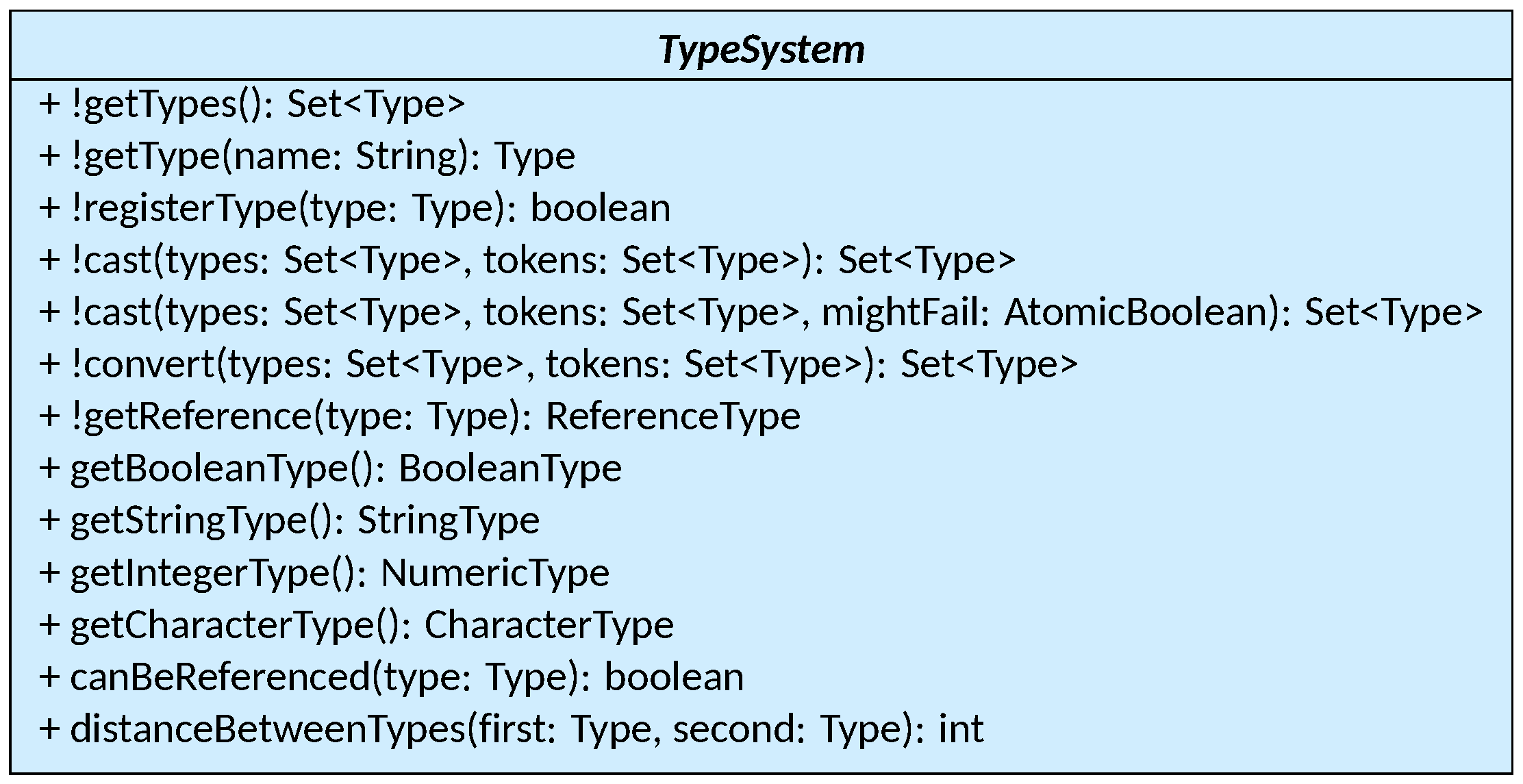
The registry methods are concrete:
getTypes()returns all types currently registered;getType(name)looks up a type by its string representation, returningnullif not found;registerType(type)adds a type to the registry usingtype.toString()as the key, returningtrueif the type was newly registered orfalseif an entry with the same name already existed.
Since LiSA works on any programming language, it has no built-in notion of available types. Registering types is essential for LiSA to have a complete type hierarchy and to be able to answer questions about type relationships during analysis. Every frontend is responsible for registering all types that can appear in the analyzed program. At startup, LiSA performs a few registrations automatically: all primitive types are registered (see below), and a
ReferenceType is registered
for each already-registered type that can be referenced.
Three methods operate on sets of types, as needed during expression analysis:
cast(types, tokens)andcast(types, tokens, mightFail)filter a set of actual types against a set ofTypeTokenTypevalues; for each token and each actual type, if the actual type can be assigned to the token’s type the actual type is kept in the result; the optionalmightFailflag is set totrueif any actual type was rejected, signalling that the cast might throw at runtime;convert(types, tokens)is likecastbut returns the target types (from the tokens) rather than the source types, modelling a conversion that changes the runtime type of the value;getReference(type)wrapstypein aReferenceTypeafter verifying viacanBeReferencedthat the language allows references to that type; it throwsIllegalArgumentExceptionif the check fails.
Note that frontends that redefine the default
ReferenceType should override getReference(type) to return the appropriate,
language-specific type instance.
The abstract methods define the language-specific behaviour that every TypeSystem implementation must provide:
getBooleanType(),getStringType(),getIntegerType(), andgetCharacterType()return the canonical instances for the four basic scalar type families;canBeReferenced(type)returnstrueif aReferenceTypewrappingtypeis valid in the language;distanceBetweenTypes(first, second)returns a non-negative integer measuring how “far apart” two types are in terms of conversions steps needed to convert the first type into the second; this distance is used during call resolution to rank candidate overloads: smaller values indicate a closer match.
Primitive Types
Primitive types are the building blocks for scalar values in a language. LiSA
defines four primitive-type interfaces: BooleanType, CharacterType,
StringType, and NumericType. All four extend Type directly.
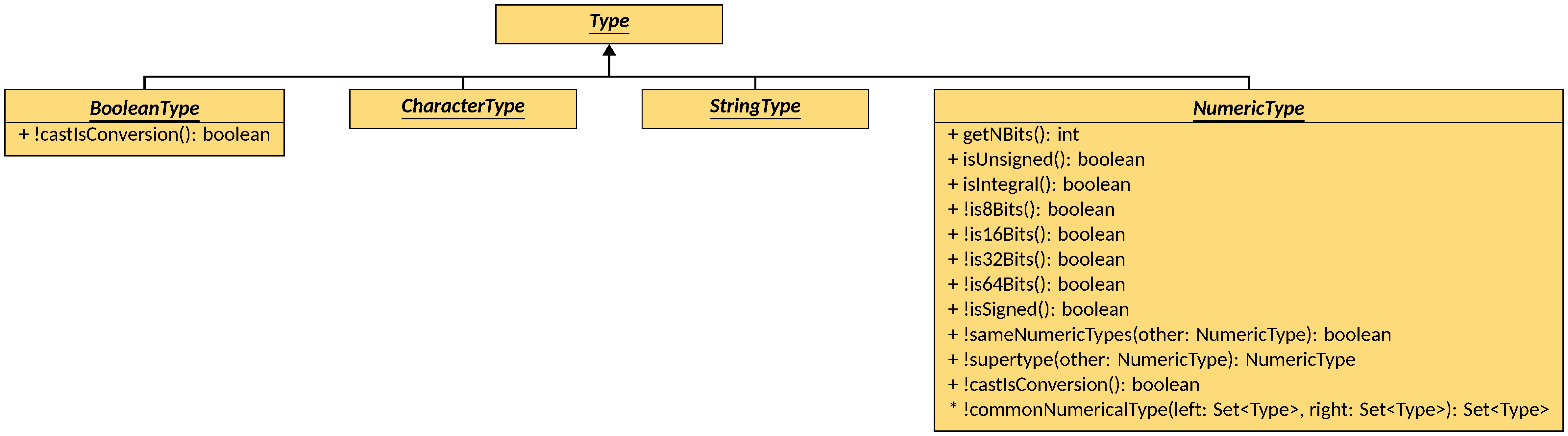
BooleanType is a marker interface for types representing boolean (true/false)
values. It overrides castIsConversion() to return true, reflecting that a
cast to or from a boolean type always converts the value.
CharacterType and StringType are pure marker interfaces — they declare no
methods beyond what they inherit from Type. A frontend creates a concrete class
implementing one of these interfaces to introduce its character or string type.
Note that type interfaces in LiSA can be combined: for instance, a Java string
is both a StringType and an InMemoryType. Thus, primitive types are not
“primitive” in the sense of being always distinct from object types; rather,
they are primitive in the sense of representing common value types that have
special semantics in most languages.
Numeric Types
NumericType is a richer interface for types that represent numbers.
It introduces three abstract methods that every numeric type must specify:
getNBits()returns the number of bits used to represent the value (typically 8, 16, 32, or 64);isUnsigned()returnstrueif the type represents an unsigned value;isIntegral()returnstrueif the type is an integer (as opposed to a floating-point) type.
The following default methods derive additional properties from those three:
is8Bits(),is16Bits(),is32Bits(),is64Bits()check whethergetNBits()equals the respective power-of-two size;isSigned()returns!isUnsigned();sameNumericTypes(other)returnstrueifotherhas the same bit width, integrality, and signedness as this type;supertype(other)returns whichever ofthisorotheris the wider type, preferring floating-point over integer and signed over unsigned when the bit width is the same;castIsConversion()returnstrue, consistent withBooleanType.
The static method commonNumericalType(left, right) computes the set of common
numeric supertypes across two sets of types. It filters both sets to numeric (or
untyped) values and, for each pair, uses commonSupertype to find the result.
Untyped values pair with any numeric type and contribute that numeric type to the
result. The method returns an empty set if both filtered sets consist entirely of
untyped values.
When implementing a numeric type, override only
getNBits(), isUnsigned(), and isIntegral(). All other methods are derived
from these three. The canonical supertype ordering (wider > narrower,
floating-point > integer, signed > unsigned) is already implemented and should
not be changed unless the language has non-standard promotion rules.
Special Types
LiSA provides three singleton types that serve as sentinels for special
situations: Untyped for values whose type is unknown or irrelevant, VoidType
for the absence of a value, and NullType for the null reference.
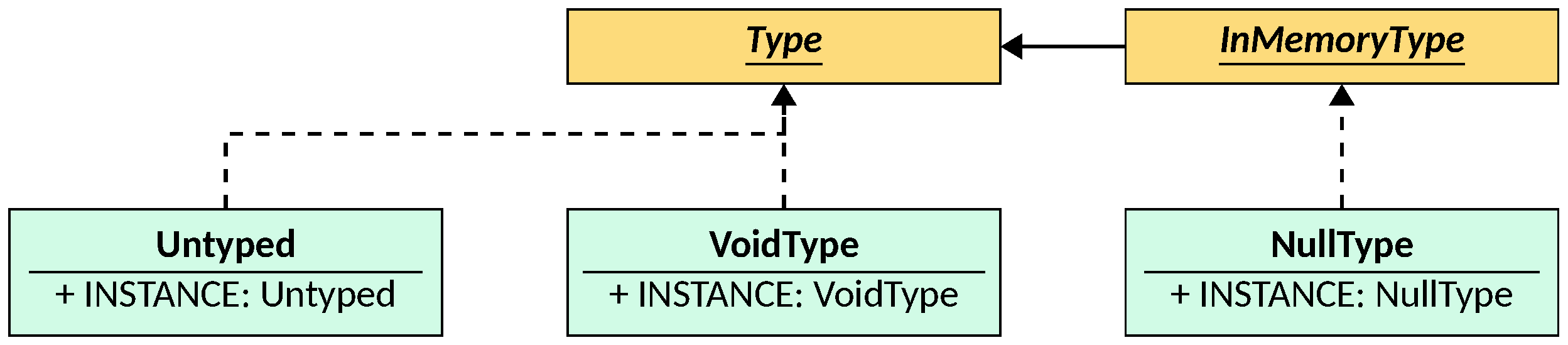
Each is implemented as a concrete class with a public static INSTANCE field
and a protected constructor, following the singleton pattern. All three override
canBeAssignedTo, commonSupertype, and allInstances with type-specific
semantics.
Untyped (Untyped.INSTANCE) represents any possible type.
It can be used in languages with dynamic typing to represent the static type of
an expression, denoting that it can be of any type.
Its assignment rules reflect this: canBeAssignedTo
returns true only when other is also Untyped, and commonSupertype
always returns Untyped.INSTANCE regardless of the other operand. When asked
for allInstances, Untyped returns all types registered in the type system,
because an untyped value could be of any known type.
VoidType (VoidType.INSTANCE) represents the return type of procedures
that produce no value. A void value is never assignable to any other type
(canBeAssignedTo always returns false), and its only common supertype with
itself is VoidType; with any other type it falls back to Untyped.INSTANCE.
NullType (NullType.INSTANCE) is the type of the null literal. It
implements InMemoryType rather than Type directly, because null can only
appear as a reference to an in-memory location. Accordingly, canBeAssignedTo
returns true for any InMemoryType or Untyped, and commonSupertype with
any InMemoryType returns that in-memory type (null is assignable to any
reference), while any other combination produces Untyped.INSTANCE.
In-Memory Types
In-memory types model structured values that are not atomic: for instance,
objects and structs that are composed of several fields, or pointers to other
memory regions. The marker interface InMemoryType extends Type and acts as
the root of this sub-hierarchy.
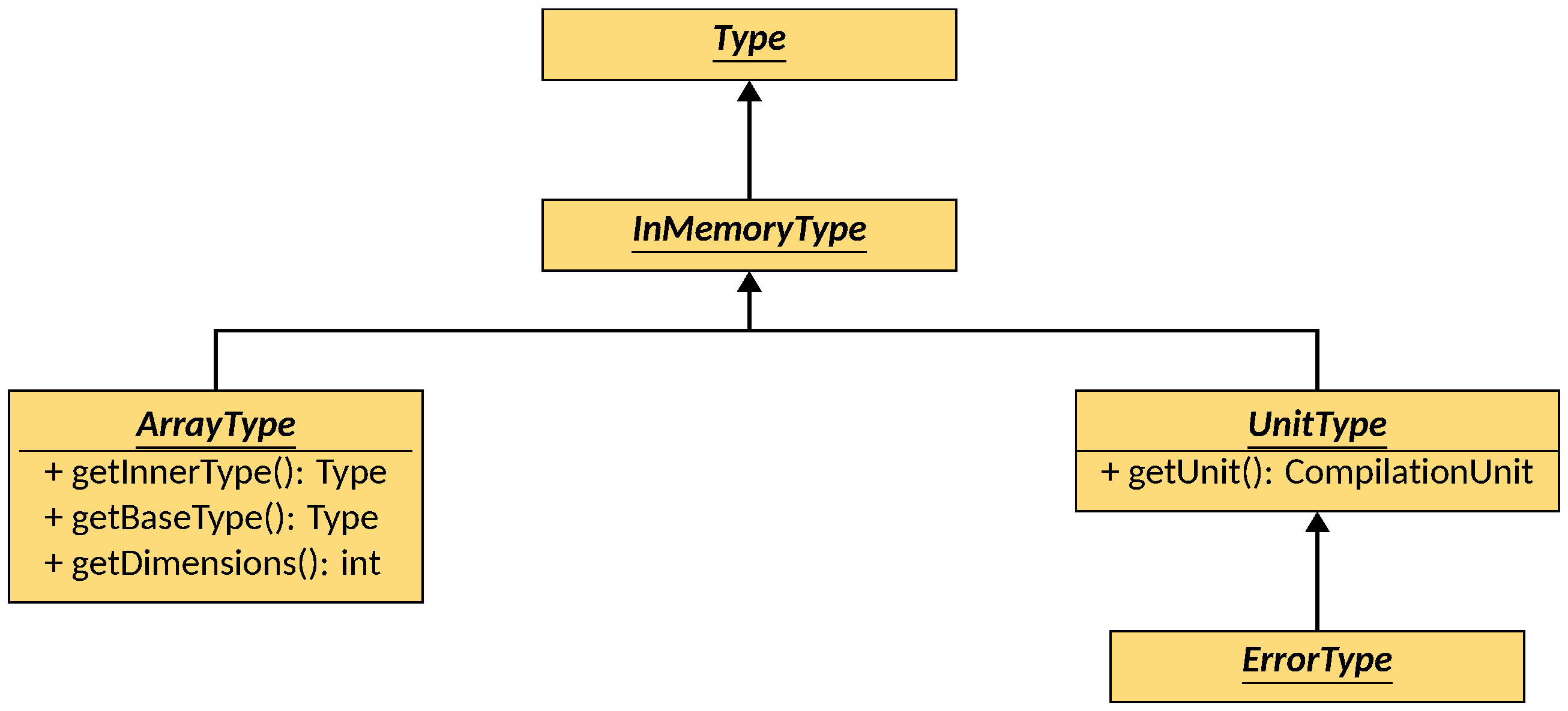
InMemoryType is a pure marker interface — its presence on a type signals that
values of that type are structured and need special handling.
isValueType() (inherited from Type) returns false for all InMemoryType
instances.
Array Types
ArrayType extends InMemoryType and represents multi-dimensional arrays. It
declares three abstract methods:
getInnerType()returns the element type of the innermost dimension of the array (i.e., the type obtained by removing one dimension);getBaseType()returns the element type of a fully dereferenced array — the type obtained by stripping all dimensions;getDimensions()returns the number of dimensions.
Frontends can implement ArrayType by providing a concrete class that pairs a base
element type with a dimension count.
Unit Types and Error Types
UnitType extends InMemoryType and represents the runtime type of an instance
of a CompilationUnit — in other words, the type of an object or struct. It declares one
abstract method, getUnit(), that returns the CompilationUnit that introduced this type.
Every frontend creates one UnitType implementation per class,
struct, or data type that can be instantiated, associating each type with its
defining unit.
ErrorType extends UnitType with no additional methods. It is a marker
interface for types whose instances can be thrown as errors or exceptions. When
a frontend models a throwable class, its associated type should implement
ErrorType so that LiSA’s exception handling logic can identify it.
Pointer Types
Pointer types represent values that refer to memory locations rather than
carrying data directly. PointerType is the root interface; ReferenceType
is the sole built-in implementation.
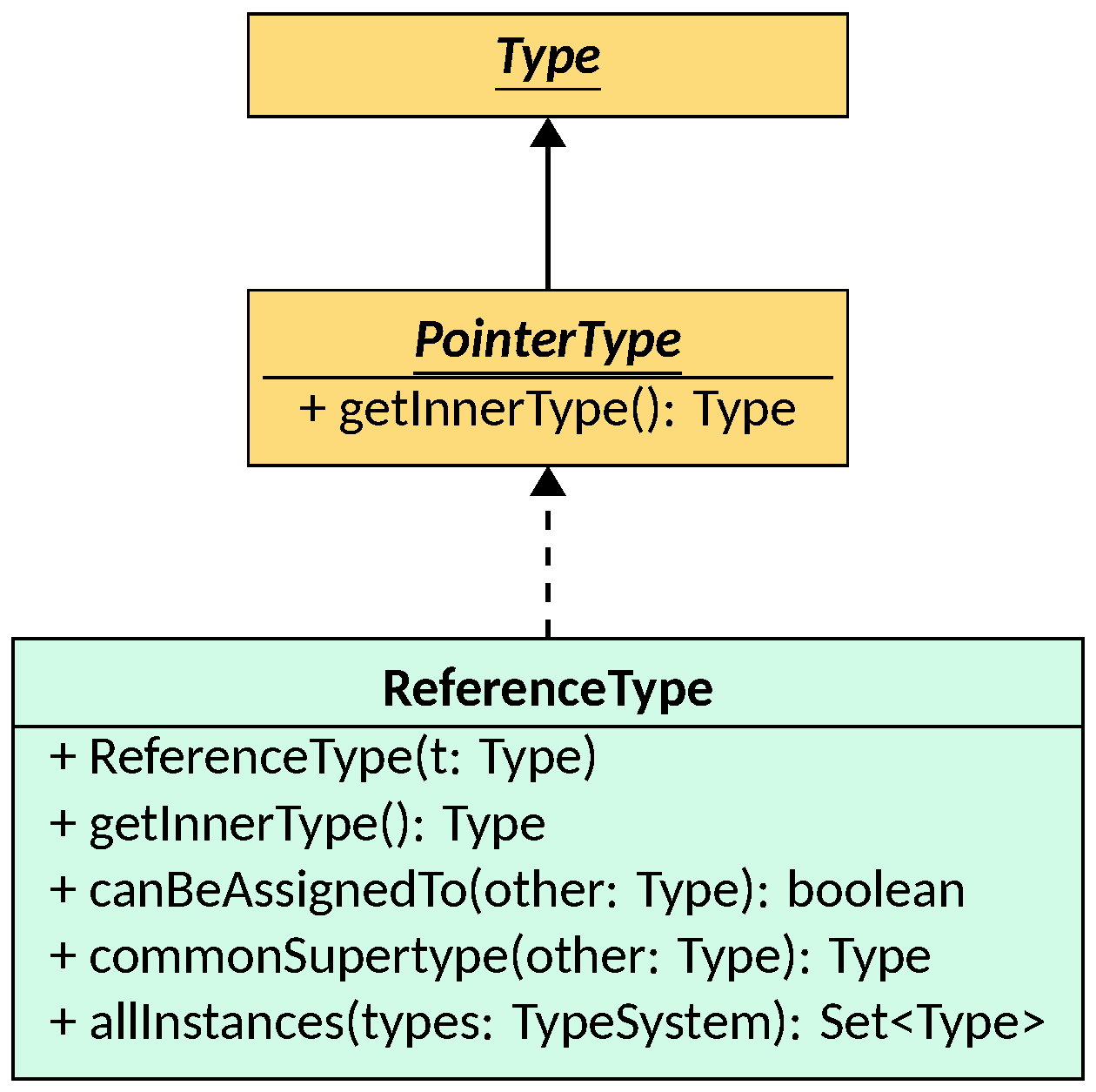
PointerType extends Type and declares one abstract method:
getInnerType()returns the type of the value that the pointer points to.
isValueType() returns false for all PointerType instances, consistent with
how pointer types behave in most languages.
ReferenceType is a concrete, value-equal class (not a singleton) that
implements PointerType. It is constructed with the inner type it points to:
ReferenceType(t)creates a reference to typet;getInnerType()returns the inner type passed at construction.
Its assignment and supertype rules are structural: canBeAssignedTo returns
true for another ReferenceType whose inner type is a supertype of this
inner type, or for Untyped. commonSupertype with another ReferenceType
constructs a new ReferenceType whose inner type is the common supertype of both
inner types; with any other type it falls back to Untyped.INSTANCE.
allInstances expands to a set of ReferenceTypes, one for each instance of
the inner type.
ReferenceType instances are created through TypeSystem.getReference(type),
which first verifies that the language allows references to type via
canBeReferenced.
Do not construct
ReferenceType objects directly
in frontend code. Always go through TypeSystem.getReference(type) so that the
language-specific canBeReferenced check is enforced.
Type Tokens
TypeTokenType represents the type of a type token: a first-class reference
to a type that appears as a value in the analyzed program. Type tokens arise, for
example, from class-literal expressions (Foo.class in Java) or arguments of cast expressions.
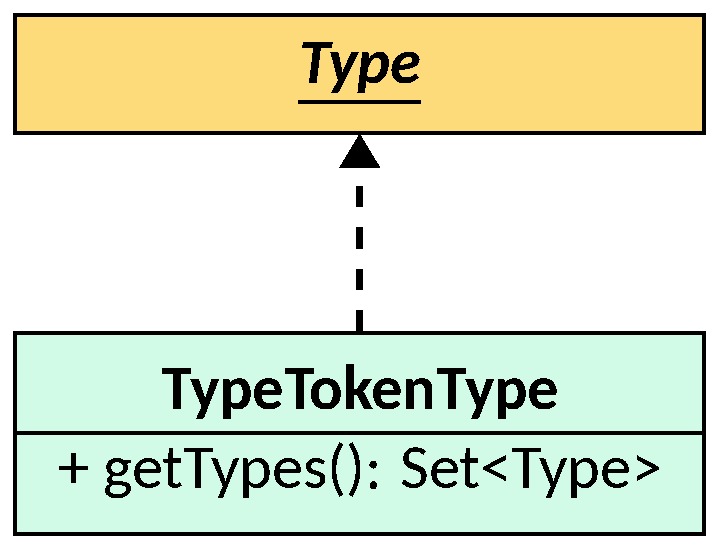
A TypeTokenType wraps a set of Type objects — the types that the token may
refer to at runtime; getTypes() returns that set.
canBeAssignedTo returns true for another TypeTokenType or for Untyped.
commonSupertype with itself returns this; with any other type it falls back
to Untyped.INSTANCE. allInstances returns a singleton set containing this
token type.
Type tokens are produced and consumed by TypeSystem.cast and
TypeSystem.convert, which use the wrapped type set to determine which actual
types are reachable through a cast or conversion operation.
When a frontend encounters a class-literal expression or a type instantiation, create a
TypeTokenType wrapping the set
of statically known target types and use it as the static type of the
expression. This allows TypeSystem.cast and TypeSystem.convert to resolve
the operation correctly during the analysis.