
Semantic Domains
Semantic domains implement transfer functions over lattice structures.
Contrary to Lattices,
a unique instance of a semantic domain is used for the whole analysis.
Such instance is the one passed as part of the
Configuration, and is thus
user-defined.
This page presents the SemanticDomain
interface, its prerequisites, its main implementation and usages.
This page contains class diagrams. Interfaces are represented with yellow rectangles, abstract classes with blue rectangles, and concrete classes with green rectangles. After type names, type parameters are reported, but their bounds are omitted for clarity. Only public members are listed in each type: the
+ symbol marks instance members, the * symbol marks
static members, and a ! in front of the name denotes a member with a default
implementation. Method-specific type parameters are written before the method
name, wrapped in <>. When a class or interface has already been introduced in
an earlier diagram, its inner members are omitted.
The Semantic Domain Interface
The SemanticDomain interface defines the available transfer functions that
anyone interacting with a domain implementation can perform over a state (i.e.,
a DomainLattice).
SemanticDomain has four type parameters:
L extends DomainLattice<L, T>defines the type of abstract states the transformers accept as parameters (see the Lattices page;Tdefines the return type of the transformers (as, in some cases, a domain implementation might want to return a pair of a state and some auxiliary information);E extends SymbolicExpressiondefines the type of SymbolicExpressions the transformers can operate on;I extends Identifierdefines the type of Identifiers the transformers can assign values to.
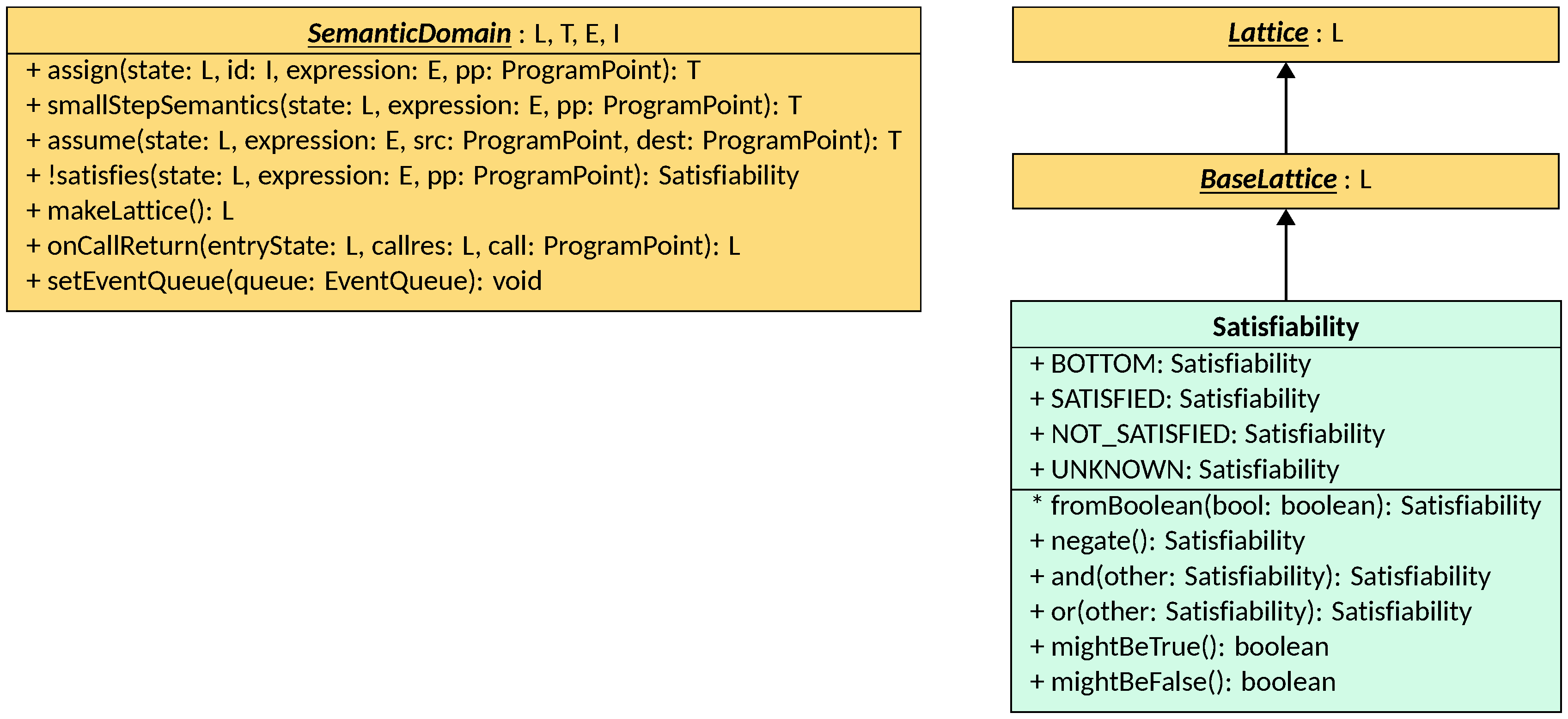
There are three main transformers defined in the SemanticDomain interface:
assign: assigns the value of a symbolic expression to an identifier in a given abstract state;smallStepSemantics: evaluates a non-assigning symbolic expression in the context of a given abstract state;assume: refines an abstract state given that a symbolic expression is known to evaluate to true.
The assign and smallStepSemantics methods are the core of any semantic domain,
and are called several times during the analysis of a program in different
places. For instance, Statements
use them to evaluate expressions and assignments, the
Interprocedural Analysis
uses assign to
model parameter passing and return value assignments, and so on.
Instead, assume is mainly called when traversing conditional
Edges in a
CFG.
Identifiers can be strong or weak.
A strong identifier represent exactly one variable or memory location: when
assigning a value to it, it is safe to forget any previous value (similarly to
what an assignment to a variable does in any programming language). A weak
identifier may instead represent multiple variables or memory locations (i.e.,
it might be a summary of several memory locations): when assigning a value to it,
it is not safe to forget previous values, as they might still be relevant.
When semantic domains assign values to weak identifiers, they must lub the new
value and the previous one together, and store the result as the new value for that
identifier.
Regardless of the domain that is being implemented, all instances of
SemanticDomain must return the bottom element
when an assignment is performed on a bottom element. This ensures that
unreachable states stay unreachable after assignments, and that errors
originating in an evaluation preceding an assignment are propagated.
SemanticDomain further defines four methods:
satisfies: checks whether a symbolic expression is satisfied or not by the information contained in the given state (mimicking the evaluation of a boolean expression);makeLattice: creates a new instance of the state (of typeL) managed by the domain (the returned instance will be used as singleton to retrieve top and bottom elements, as well as serving as a starting state for the analysis);onCallReturn: invoked by the Interprocedural Analysis when returning from a call to perform any necessary cleanup or state update;setEventQueue: called at the start of the analysis to provide the domain with a reference to the analysis Event Queue (implementations of this method should invoke it on nested domains, and optionally store the queue in a field for later usage).
The satisfies method returns an instance of Satisfiability, a Lattice instance
that models sets of boolean values (i.e., true, false, both, or none).
Implementing
assume might be tricky. A simple and
sound starting point is to implement it by returning the input state unchanged.
If you implement satisfies, you can have assume return bottom when the
input state does not satisfy the expression, and return the input state
unchanged otherwise.
If no event listeners are registered for the analysis, the
setEventQueue method will not be called. If your domain issues
events, make sure to null-check the event queue before using it.
The Abstract Domain Interface
The AbstractDomain interface is a specialization of SemanticDomain that
defines what a user of LiSA has to provide to implement an analysis.
It is parametric on the type L, which extends AbstractLattice<L>, that is
the concrete type of Abstract Lattices
managed by the domain. The interface extends SemanticDomain<L, L, SymbolicExpression, Identifier>,
meaning that the transformers return instances of the same type as the input state, and
that they operate on generic symbolic expressions and identifiers.
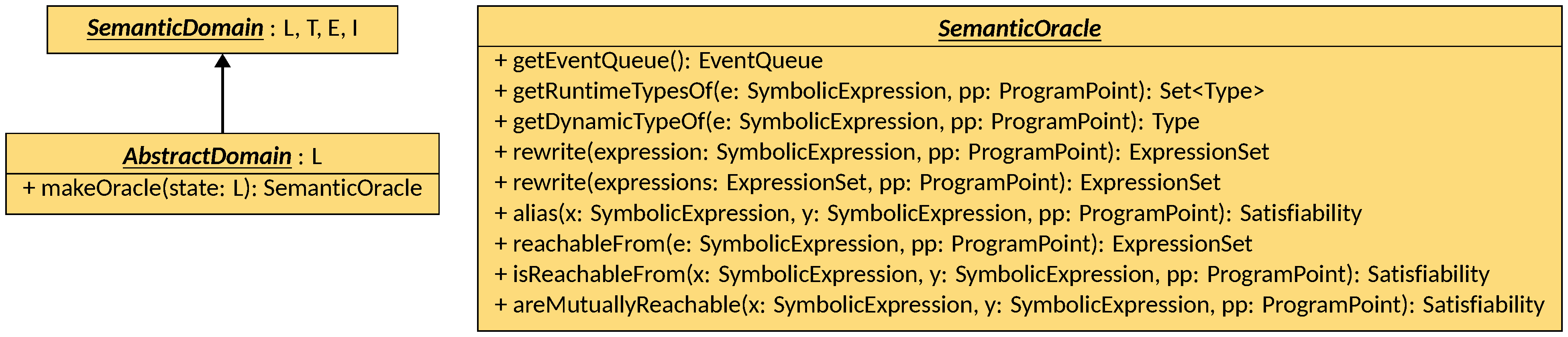
AbstractDomain adds one additional method to those already defined in
SemanticDomain: makeOracle. This method returns a SemanticOracle, that
roughly corresponds to a pair of the domain and a specific abstract state at a
given program point. The oracle can be used to query the domain about properties
that hold in that specific state:
- it can be used to retrieve the event queue through
getEventQueue; - it can be used to inspect the runtime types or the dynamic type (i.e., the
lubof all possible runtime types) of expressions; - it can be used to rewrite expressions into simpler forms, given the information available in the state;
- it can be used to query information about the memory structure of the program (e.g., aliasing or reachability).
Finally, the hasWholeValueAnalysis and the constraints methods can be used,
in case of the adoption of the SimpleAbstractDomain
framework, to obtain information on the value of an expression. More on this is
available in the Simple Abstract Domain page.
Note that the oracle must be sound, but it is not required to be as precise
as possible: for instance, the oracle might return all possible types when asked
for the runtime types of an expression. Such information will be used
throughout the analysis, e.g. when resolving call targets or when computing the
semantics of a statement. The more precise the oracle is, the more precise the analysis
will be, but also the more expensive it will be to compute.
For a list of abstract domains already implemented in LiSA, see the Configuration page.
The Analysis Class
The Analysis class is the central component that LiSA uses to evolve
Analysis States.
Since the AbstractDomain used for an analysis is user-provided, this allows
analysis-independent implementations of other components (like statement semantics
or interprocedural analyses): there is no compile-time binding between these entities
and the concrete instances of AbstractDomain that will be executed,
thus all operations that are performed by such entities have to be agnostic of the
actual domain in place. This ensures a high level of modularity: all internal
analysis components can be changed or replaced without requiring any modification
of external ones.
The Analysis class is parametric on the type D, that extends
AbstractDomain<A>, of the abstract domain to use during the analysis, and
on the type A, that extends AbstractLattice<A> of the
Abstract Lattices
managed by D.
Similarly to AbstractDomain, the Analysis class implements
SemanticDomain<AnalysisState<A>, AnalysisState<A>, SymbolicExpression, Identifier>,
meaning that the transformers return instances of the same type as the input state
(that is, of the Analysis State), and
that they operate on generic symbolic expressions and identifiers.
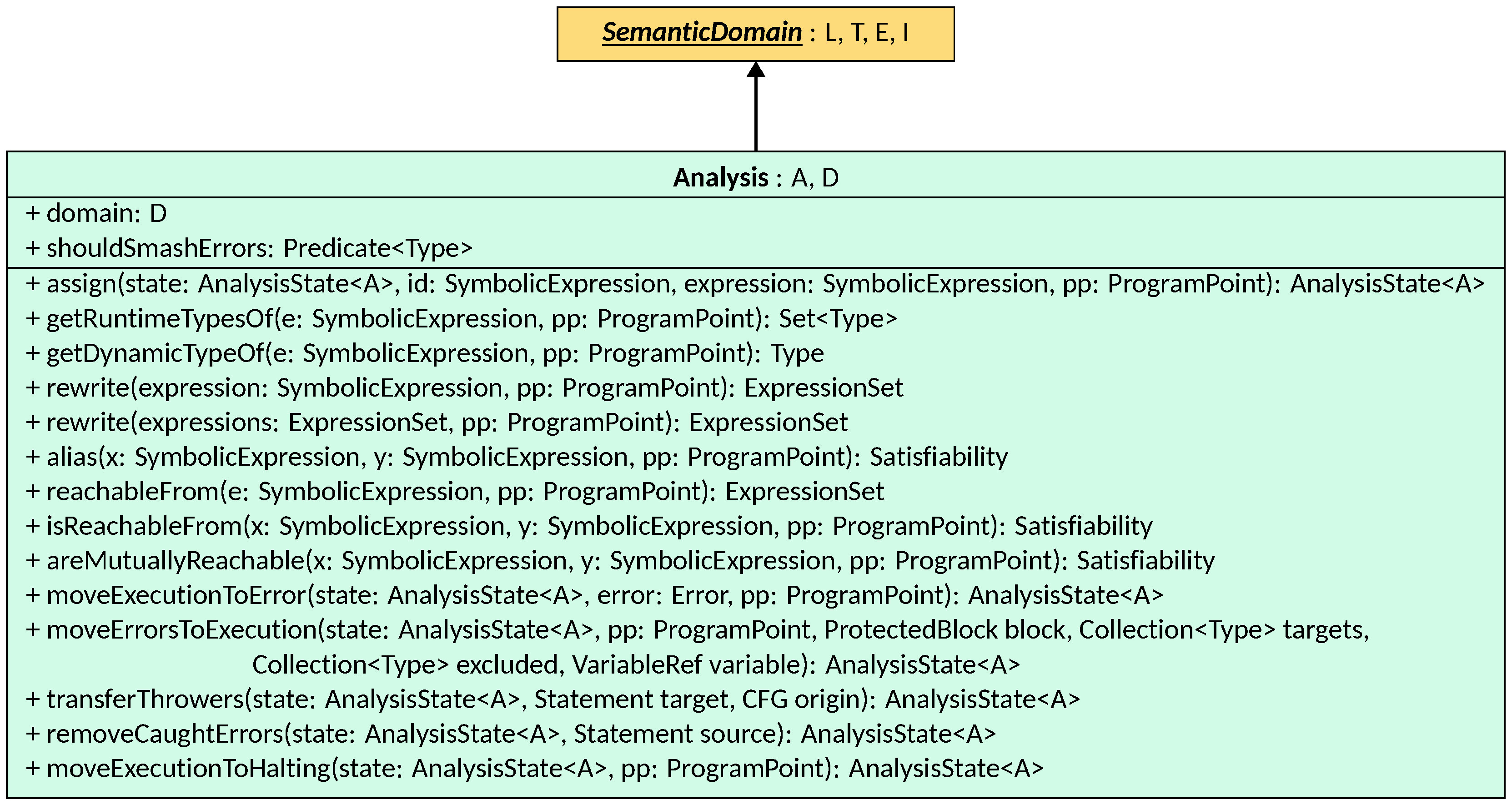
The Analysis class contains the domain to execute and the
shouldSmashErrors predicate as fields. The latter is a predicate passed to
LiSA as part of the Configuration that
decides which error types are not interesting for the user, and can thus be
“smashed” inside the analysis state.
Transformers defined by SemanticDomain are implemented by invoking the
corresponding operation on the domain, using the normal execution continuation
as source. The expression that has been evaluated (or, in the case of
assignments, the Identifier that has been assigned) is stored in the
ProgramState’s computed expressions.
Analysis also provides several additional methods:
- a variant of
assignthat takes in an arbitrarySymbolicExpressionas the left-hand side, that will be rewritten throughrewriteas necessary to obtain anIdentifier; - convenience wrappers around
SemanticOraclemethods, that simply create the oracle throughdomain.makeOracleand invoke the corresponding method on it; - methods to manage the alternating of the state between the normal execution
and other continuations:
moveExecutionToErrorsets the normal execution to bottom, and moves the input normal execution to either an error continuation or the smashed errors continuation, depending on the result ofshouldSmashErrors;moveErrorsToExecutiontransfers the least upper bound of the error states that can be assigned to one of thetargetstypes but to none of theexcludedtypes to the normal execution, optionally assigning the error left on the stack to the providedvariable, if any;transferThrowersmodifies the error continuations by changing the instruction that threw them if it was inside theoriginCFG (this is useful for moving throwers from callee to caller, such that error catching constructs can correctly identify if they should handle them);removeCaughtErrorsremoves from the error continuations all errors that are caught by incoming edges into the givensource;moveExecutionToHaltingsets the normal execution to bottom, and moves the input normal execution to the halting continuation.