
Language Features
A static analysis framework must cope with the diversity of programming languages:
how calls are resolved, how arguments are matched to parameters, how the analysis
state is scoped when entering a function, how errors are propagated, and what
structural invariants a well-formed program must satisfy all vary from one language
to the next. In LiSA, these concerns are encapsulated in a set of pluggable
strategy interfaces that are grouped together by the LanguageFeatures abstract
class and attached to a Program at construction time.
This page describes LanguageFeatures and each of the five strategy interfaces
it composes: the parameter matching strategy used to resolve calls, the hierarchy
traversal strategy used to walk type hierarchies, the parameter assigning strategy
that prepares analysis state before entering a callee, the scoping strategy that
manages variable visibility across call boundaries, and the program validation
logic that checks structural correctness before the analysis begins.
This page contains class diagrams. Interfaces are represented with yellow rectangles, abstract classes with blue rectangles, and concrete classes with green rectangles. After type names, type parameters are reported, but their bounds are omitted for clarity. Only public members are listed in each type: the
+ symbol marks instance members, the * symbol marks
static members, and a ! in front of the name denotes a member with a default
implementation. Method-specific type parameters are written before the method
name, wrapped in <>. When a class or interface has already been introduced in
an earlier diagram, its inner members are omitted.
The LanguageFeatures class
LanguageFeatures is the abstract class that a frontend must subclass to declare
the language-specific behaviour of the program it is modeling. An instance of
LanguageFeatures is passed to Program and exposed through
Program.getFeatures(), making it available throughout the analysis engine.
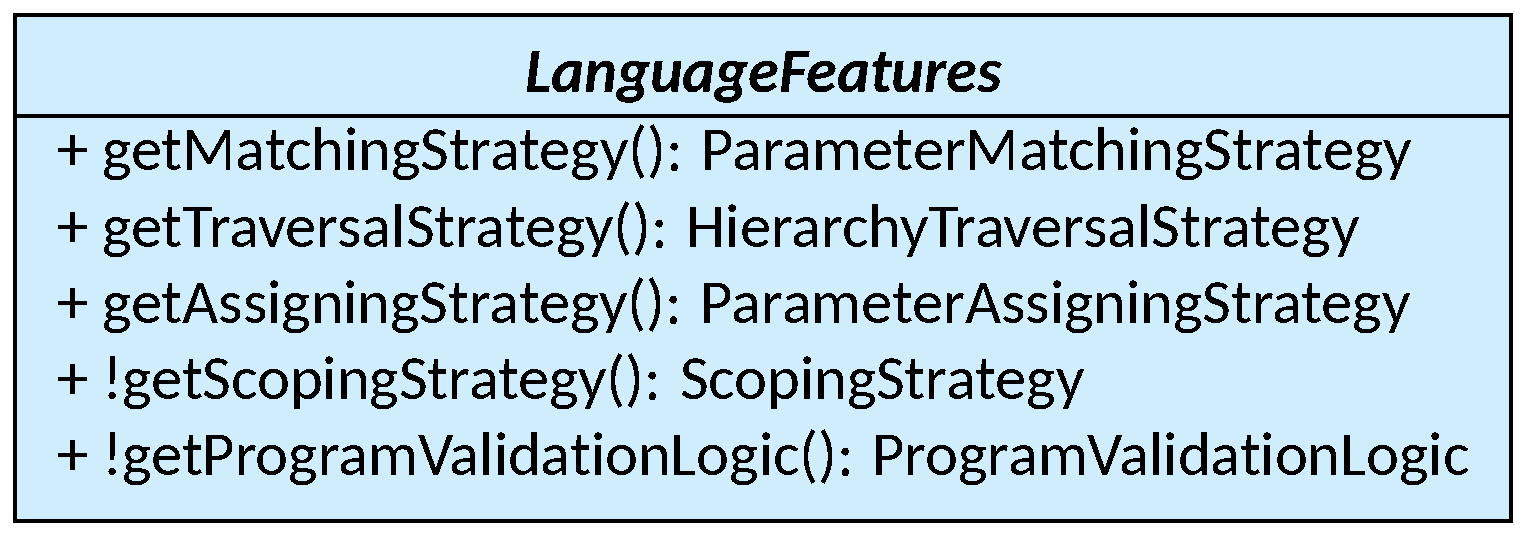
Three methods are abstract and must be implemented by every frontend:
getMatchingStrategy()returns theParameterMatchingStrategyused to decide whether a given call site is compatible with a candidate callee;getTraversalStrategy()returns theHierarchyTraversalStrategyused to enumerate the units that should be searched for a matching callee when resolving a virtual call;getAssigningStrategy()returns theParameterAssigningStrategyused to bind actual arguments to formal parameters in the analysis state before entering a callee.
Two further methods have default implementations and may optionally be overridden:
getScopingStrategy()returns aDefaultScopingStrategy, which pushes the analysis state into the callee’s scope and pops it on return;getProgramValidationLogic()returns aBaseValidationLogic, which performs structural validation of theProgrambefore the analysis starts.
Call Resolution
When LiSA encounters an unresolved call, it must determine which concrete code
member(s) the call may target. This involves two steps: traversing the type
hierarchy to find candidate units (via
HierarchyTraversalStrategy), and then
checking each candidate’s signature against the call (via
ParameterMatchingStrategy). This section covers the matching step.

ParameterMatchingStrategy is the interface that decides whether a call’s actual
arguments are compatible with a candidate callee’s formal parameters. It exposes
two methods:
matches(call, formals, actuals, types)is the core abstract method: given the call site, the formal parameter list of the candidate, the actual argument expressions, and the runtime type sets of each argument, it returnstrueif the call matches this candidate;distanceFromPerfectTarget(call, types, cm, instance)is a default method that computes an integer distance between the call and a candidate code member; a distance of0means a perfect match; larger values indicate that type widening was needed;-1signals that the candidate is incompatible; this value is used by the call resolution engine to rank candidates when multiple matches are found, usingTypeSystem.distanceBetweenTypesfor per-parameter distances.
Fixed-Order Strategies
FixedOrderMatchingStrategy is an abstract class that implements
ParameterMatchingStrategy for calls where the number of actuals must equal
the number of formals and each argument is matched positionally. Its concrete
matches implementation checks that formals.length == actuals.length and then
delegates each position to the abstract single-position method
matches(call, pos, formal, actual, types), that checks whether the single actual
argument at position pos, with the given runtime type set, is compatible with
the corresponding formal parameter.
Three ready-to-use singleton implementations are provided:
RuntimeTypesMatchingStrategy.INSTANCEaccepts a call at positionposif any runtime type intypescan be assigned to the formal’s static type; this is appropriate for virtual (instance) calls where the runtime type is what matters;StaticTypesMatchingStrategy.INSTANCEaccepts a call at positionposif the actual expression’s static type can be assigned to the formal’s static type. This is appropriate for static calls and in languages without subtype polymorphism;JavaLikeMatchingStrategy.INSTANCEcombines both: for the receiver argument (position0of an instance call) it uses runtime types; for all other arguments it uses static types; this models the Java virtual dispatch rule.
Python-Like Matching
PythonLikeMatchingStrategy implements ParameterMatchingStrategy for languages
that support default parameter values and keyword (named) arguments. It is
constructed with a FixedOrderMatchingStrategy delegate that is used once the
positional and keyword slots have been filled in.
Its matches implementation performs matching in three phases:
- positional arguments — actual arguments are assigned to the corresponding
formal slots in order, stopping as soon as a
NamedParameterExpressionis encountered (i.e., an expression of the formpar_name=some_value); - keyword arguments — each remaining
NamedParameterExpressionis matched to the formal whose name equals the parameter name and assigned to that slot; - default values — any formal slot left unfilled is assigned its declared default value expression; if no default exists the call is rejected.
The logic for these three phases is factored into the generic static method
pythonLogic, which operates over arbitrary element types T and failure
values F. This allows the same algorithm to be shared between
PythonLikeMatchingStrategy (which fills Expression slots) and
PythonLikeAssigningStrategy (which fills ExpressionSet slots during the
analysis).
Parameter Assignment
Once a callee has been resolved, LiSA must bind the actual arguments to the
formal parameters in the analysis state before starting the fixpoint on the
callee’s CFG. The ParameterAssigningStrategy encapsulates this binding.

ParameterAssigningStrategy declares one abstract generic method:
prepare(call, callState, interprocedural, expressions, formals, actuals)takes the analysis state at the call site, the resolved formals, and theExpressionSetarrays produced for each actual argument, and returns a pair of the post-assignment analysis state and theExpressionSetarray with an element for each formal parameter.
Two implementations are provided:
OrderPreservingAssigningStrategy.INSTANCE assigns each actual expression to
the corresponding formal variable in order. For each formal, it computes the
join over all symbolic expressions in the corresponding ExpressionSet, using
the abstract domain’s assign operation to bind each expression to the formal’s
symbolic variable. This strategy is appropriate for any language where arguments
are passed positionally with no defaults or keyword arguments.
PythonLikeAssigningStrategy.INSTANCE extends the positional strategy to
handle default values and keyword arguments. It first evaluates the default
value expression for each formal that has one (running forward semantics on the
default expression to obtain its ExpressionSet), then uses the same
pythonLogic algorithm from PythonLikeMatchingStrategy to fill in the
ExpressionSet slots for each formal. Only after the slots are filled does it
run the order-preserving assignment loop.
Hierarchy Traversal
When a yet-to-be-resolved call (i.e., an
UnresolvedCall)
needs to be resolved, LiSA must know which units to search for a
matching callee. The HierarchyTraversalStrategy determines the order in which
ancestor units are visited.
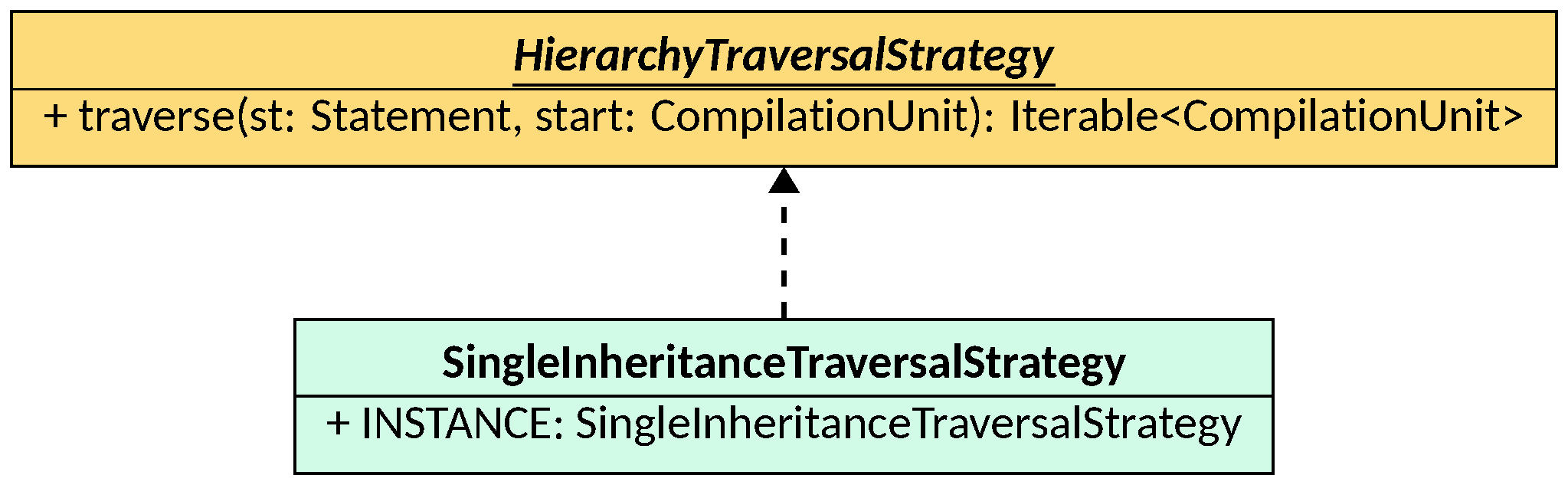
HierarchyTraversalStrategy is an interface that defines a single method,
traverse(st, start), that returns an Iterable<CompilationUnit> that enumerates
the units to search, starting from start (the static receiver type) and
walking up or across the hierarchy as appropriate for the language.
SingleInheritanceTraversalStrategy.INSTANCE implements a breadth-first walk
of the ancestor hierarchy starting from the given unit. At each step it visits
the current unit and its immediate ancestors. This strategy is suitable for
single-inheritance languages (e.g., Java classes), where at most one superclass
exists at each level, though it correctly handles the presence of interfaces by
processing all immediate ancestors.
For languages with multiple inheritance, implement a custom
HierarchyTraversalStrategy that defines the linearisation order
appropriate for the language (e.g., C3 linearisation for Python). The traversal
strategy only determines the search order; the final selection among matching
candidates is handled by the matching and assigning strategies.
Scoping
When the analysis enters a callee, local variables of the caller must not
interfere with local variables of the callee that share the same name.
ScopingStrategy manages this by pushing and popping variable scopes around
each call.
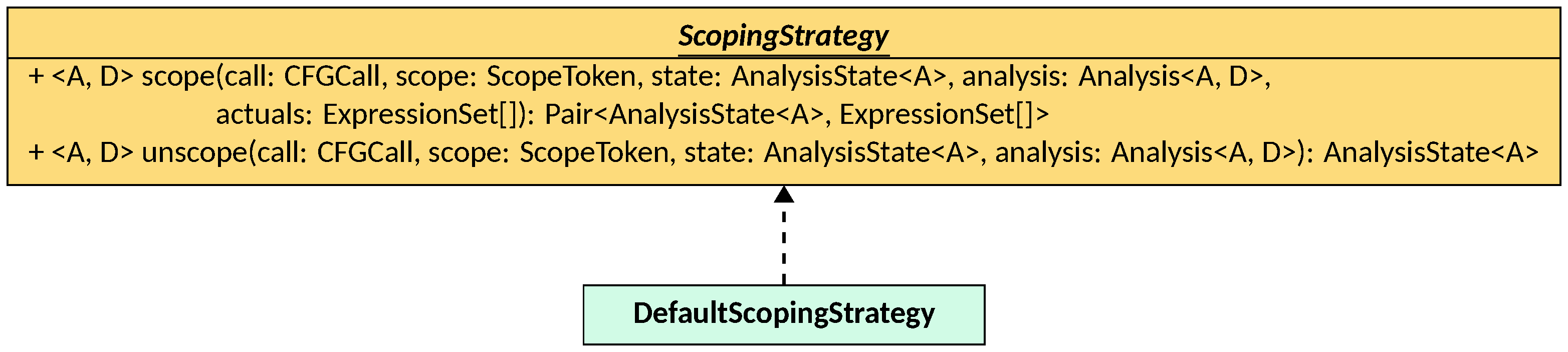
ScopingStrategy is an interface with two abstract methods:
scope(call, scope, state, analysis, actuals)prepares the analysis state for entry into a callee identified by the givenScopeToken; it returns a pair of the scoped state and the correspondingly scopedExpressionSetarrays for the actual arguments;unscope(call, scope, state, analysis)restores the analysis state after returning from the callee; if the call returns a value, it assigns the callee’s return expressions to the call’s meta-variable before popping the scope.
DefaultScopingStrategy implements both methods. Its scope implementation
calls AnalysisState.pushScope to push the scope token onto the analysis state
and applies ExpressionSet.pushScope to each actual expression so that the
symbolic names of the actuals are correctly translated into the callee’s scope.
Its unscope implementation checks whether the call returns a value: if not, it
simply pops the scope; otherwise, it assigns each return expression to the call’s
meta-variable (joining over all return expressions) and then pops the scope.
Program Validation
Before starting the analysis, LiSA validates the Program to catch structural
errors introduced by the frontend. The ProgramValidationLogic interface
encapsulates this validation pass.
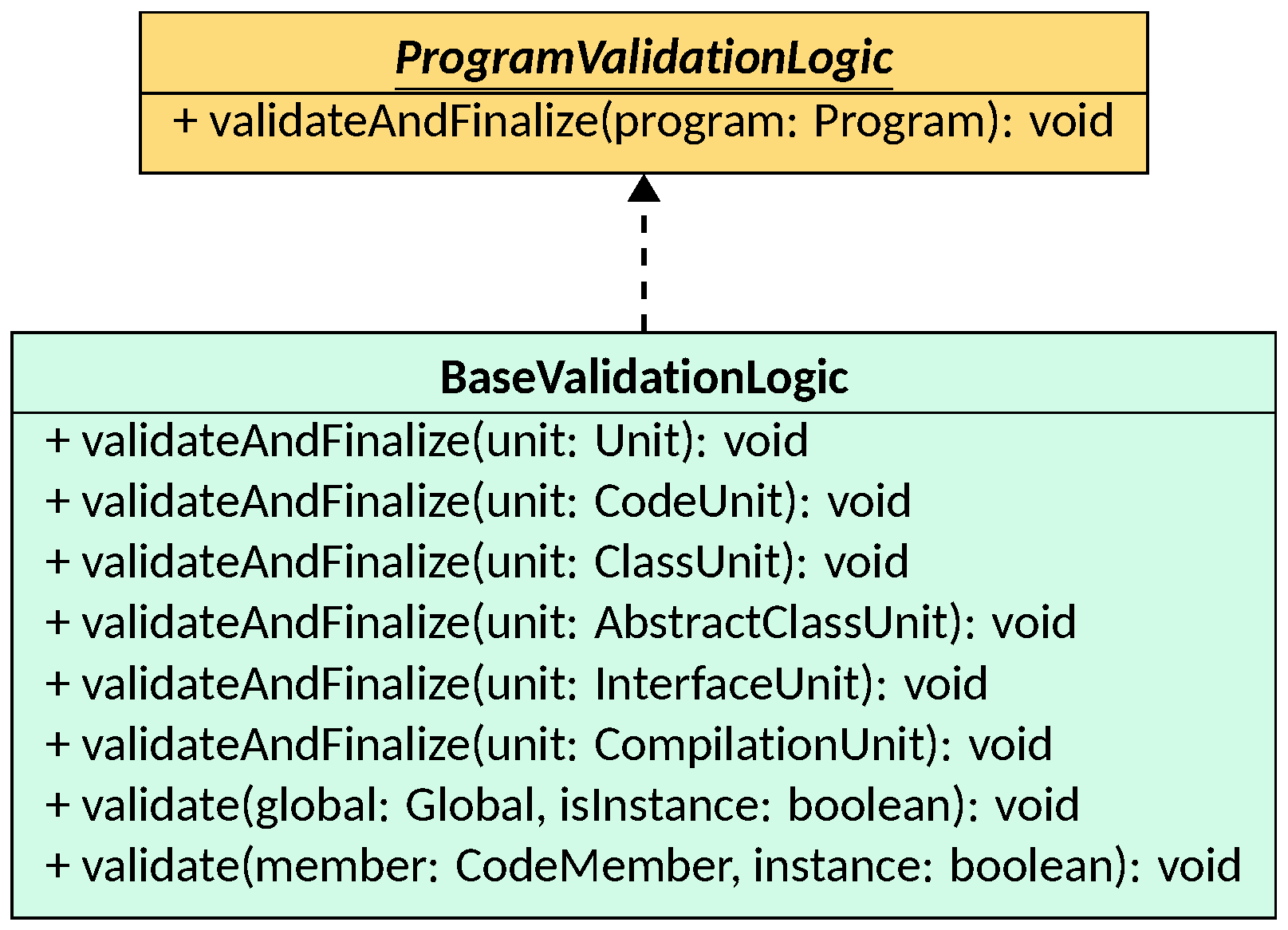
ProgramValidationLogic is an interface with one abstract method:
validateAndFinalize(program). The latter inspects the program’s units, code members,
globals, and entry points for structural violations and throws a
ProgramValidationException describing the first violation found. It also
finalizes the program (e.g., populating override and annotation chains) so that
the analysis engine can assume a fully resolved program.
BaseValidationLogic is the default implementation. It provides a family of
overridable validateAndFinalize and validate methods organized by the type
of element being checked that perform the minimal checks on each component:
validateAndFinalize(Program)verifies that all entry points are part of the program, then delegates to per-unit validation;validateAndFinalize(Unit)dispatches to the appropriate typed overload based on the runtime type of the unit;validateAndFinalize(CodeUnit)performs no additional checks (procedural units have no inheritance constraints);validateAndFinalize(CompilationUnit)is the central method: it recursively validates ancestors, resolves override chains (populatingoverridesandoverriddenByon each code member’s descriptor), propagates inherited annotations from ancestors to subunits and overriding members, and registers the unit as an instance of itself;validateAndFinalize(ClassUnit)checks that a concrete class has no unresolved abstract members;validateAndFinalize(AbstractClassUnit)checks that an abstract class is not sealed;validateAndFinalize(InterfaceUnit)checks that an interface declares no instance globals;validate(Global, isInstance)checks that the global’s instance flag is consistent with how it is registered in its unit and that constant globals are not declared as instance globals;validate(CodeMember, instance)checks that the member is registered exactly once in its unit under the correct instance/static category, and callsCodeMember.validate()to run any member-level checks.
CodeMember.validate() results in calls to CFG.validate(), that (i) ensures
that all control flow structures are well-formed (e.g., all nodes are actually
part of the CFG), (ii) ensures no execution-stopping nodes (i.e., ones where
stopsExecution() returns true) have successors, (iii) ensures that nodes
that do not stop execution have at least one successor, and (iv) checks that
all entrypoints of the CFG are actual nodes of the CFG. Then, it launches
validation of the inner NodeList, which checks that all edges’ endpoints are
part of the NodeList.
Frontends that model a language with additional
structural constraints (e.g., a no-cyclic-inheritance rule or restrictions on
interface method visibility) should subclass BaseValidationLogic and override
the relevant validateAndFinalize overload. The processedUnits set ensures
that each unit is only visited once even when the overriding method calls
super.
validateAndFinalize is called exactly once
per analysis, just before the fixpoint computation starts. At the moment it is
called, the program graph is fully constructed: all units, code members, globals,
and entry points are already in place. After validateAndFinalize returns, the
override and annotation chains are considered final and must not be modified.